Medieval Trade
Medieval Trade: The Foundations of Europe’s Commercial Power
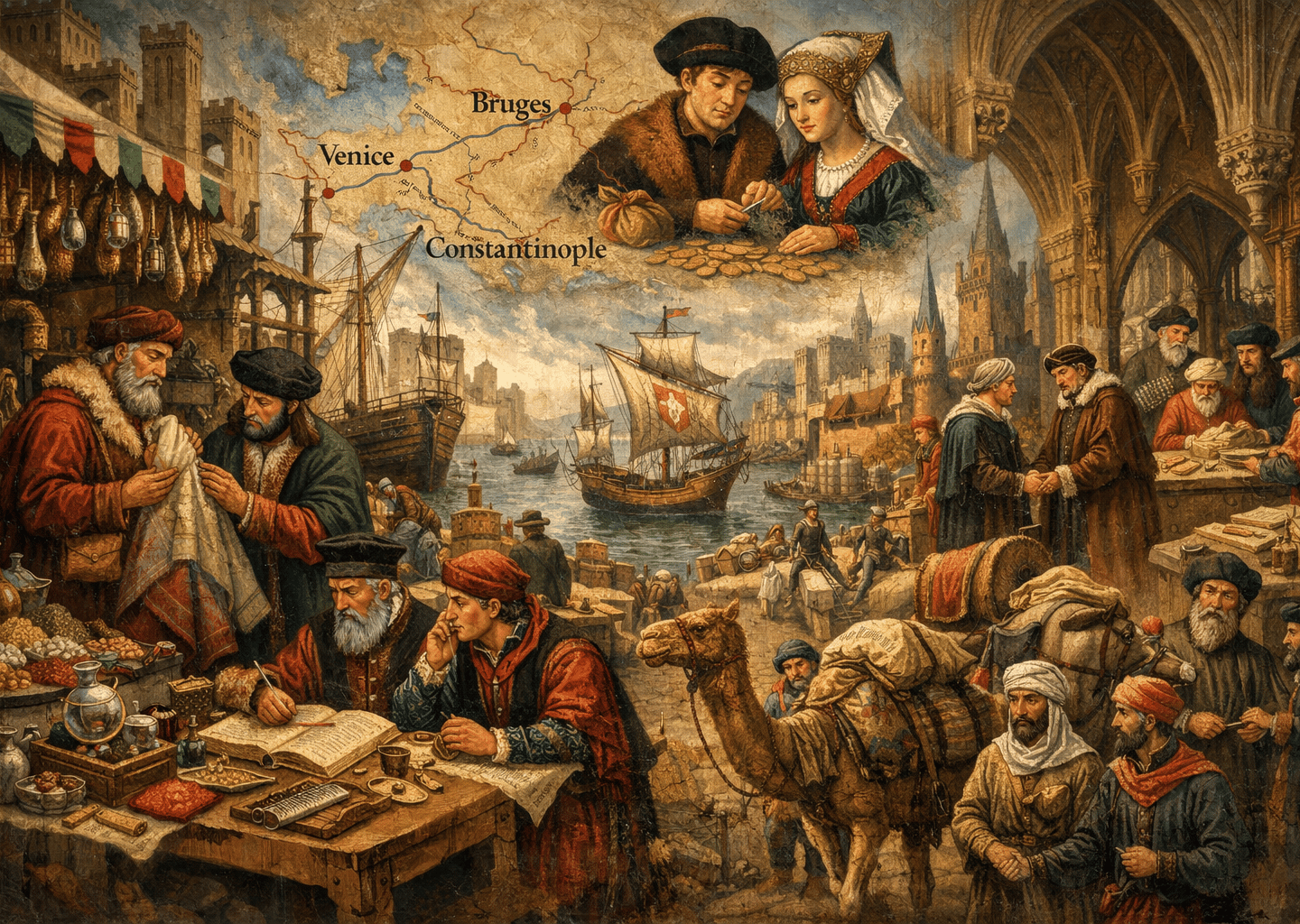
Medieval trade formed the economic backbone of Europe between the 11th and 15th centuries, linking distant regions through vast networks of merchants, ports, and caravan routes. While the medieval world is often imagined as a patchwork of isolated kingdoms and feudal estates, the reality was far more interconnected. Across land and sea, merchants carried goods, currency, and ideas across thousands of kilometres, gradually weaving together an economic system that would lay the foundations for the modern European economy.
During this period, trade expanded dramatically as population growth, agricultural improvements, and urban development increased demand for goods beyond local production. Markets that had once served small regional communities grew into vibrant centres of international commerce. Merchant caravans travelled along established routes through Central Europe and the Mediterranean, while ships sailed from port to port carrying cargo that linked the economies of distant regions.
In the south, the merchant cities of Italy became some of the most powerful trading centres in Europe. Cities such as Venice, Genoa, and Florence developed thriving commercial networks that connected Europe with the wealthy markets of the Byzantine Empire and the Islamic world. Through these connections, luxury goods such as spices, silk, fine textiles, and precious stones flowed into European markets. These goods were rare and expensive, making them symbols of status among nobles, wealthy merchants, and royal courts.
Meanwhile, in Northern Europe, trade networks expanded through alliances between merchant cities. One of the most influential commercial organisations of the medieval period was the Hanseatic League. This alliance of trading cities dominated commerce across the Baltic and North Seas, connecting regions such as Germany, Scandinavia, England, and the Low Countries. The Hanseatic merchants controlled the flow of key commodities including timber, grain, fish, wax, and furs, creating a powerful network that protected trade routes and regulated commercial activity across northern Europe.
Trade in medieval Europe was not limited to the exchange of goods. It also became a conduit for the movement of knowledge, financial innovation, and cultural influence. Merchants introduced new accounting methods, credit systems, and partnership structures that allowed trade to expand far beyond the limitations of physical currency. Letters of credit and early banking systems made it possible for merchants to conduct transactions across long distances without transporting large amounts of coin, reducing the risks of theft and loss.
These financial innovations helped create a new class of powerful merchant families who understood that wealth could be multiplied through finance as well as trade. Over time, many of these families transformed their commercial success into long-lasting dynasties. Through strategic investments, partnerships, and political alliances, they gained influence not only in markets but also in the courts of kings and emperors.
Among the most famous of these commercial dynasties was the Fugger family of Augsburg. Beginning as textile merchants in the 15th century, the Fuggers expanded into mining, banking, and international finance. Their wealth grew so large that they were able to lend money to monarchs and fund the ambitions of rulers across Europe. At their peak, they helped finance the rise of Charles V, demonstrating how commercial wealth could translate directly into political influence.
Other merchant families followed similar paths, using trade profits to acquire land, titles, and prestige. Over time, the boundary between merchant wealth and noble status began to blur. Successful traders married into aristocratic families, funded public works, sponsored churches, and became influential figures in the political life of their cities. This gradual transformation marked the beginning of a new social order in which financial power could rival the authority of traditional feudal elites.
Control of supply routes was one of the most important strategies for building wealth during this period. Merchant houses that secured reliable access to valuable resources—whether silver mines, wool production, or spice routes—could dominate entire sectors of trade. By controlling these supply chains, they could influence prices, negotiate favourable agreements, and accumulate fortunes that far exceeded the income of many noble families.
Trade also stimulated the growth of cities. Ports and market towns became centres of economic activity where merchants, craftsmen, bankers, and labourers gathered to support the expanding commercial economy. Cities such as Venice, Bruges, and Lübeck flourished as hubs of trade, attracting wealth and talent from across the continent. These urban centres became incubators of innovation, where new ideas about commerce, governance, and culture began to flourish.
As trade networks expanded, they gradually transformed European society. Wealth was no longer derived solely from land ownership or feudal allegiance. Instead, economic influence increasingly flowed from commerce, finance, and international partnerships. Merchant elites learned that power could be built not just through military strength, but through strategic control of resources, capital, and trade routes.
By the late medieval period, these developments had begun to reshape the balance of power across Europe. Merchant dynasties, banking houses, and trading leagues were quietly accumulating wealth and influence that would help drive the economic transformations of the Renaissance. The commercial foundations laid during the medieval period enabled new forms of enterprise, exploration, and investment that would eventually propel Europe into an age of global trade and financial expansion.
For readers interested in exploring how these commercial networks transformed medieval society and built the fortunes of Europe’s early elites, a recommended resource is the book The Verge: Reformation, Renaissance, and Forty Years That Shook the World by Patrick Wyman. The work offers a compelling exploration of the economic, political, and cultural forces that emerged from this transformative era, illustrating how trade, finance, and ambition combined to reshape the trajectory of European history.
Contact
Reach out for insights or collaboration.
Phone
© 2025. All rights reserved.