The House of Habsburg – Marriage as Expansion
“Let others wage war; you, fortunate Austria, marry.”
3/28/20266 min read
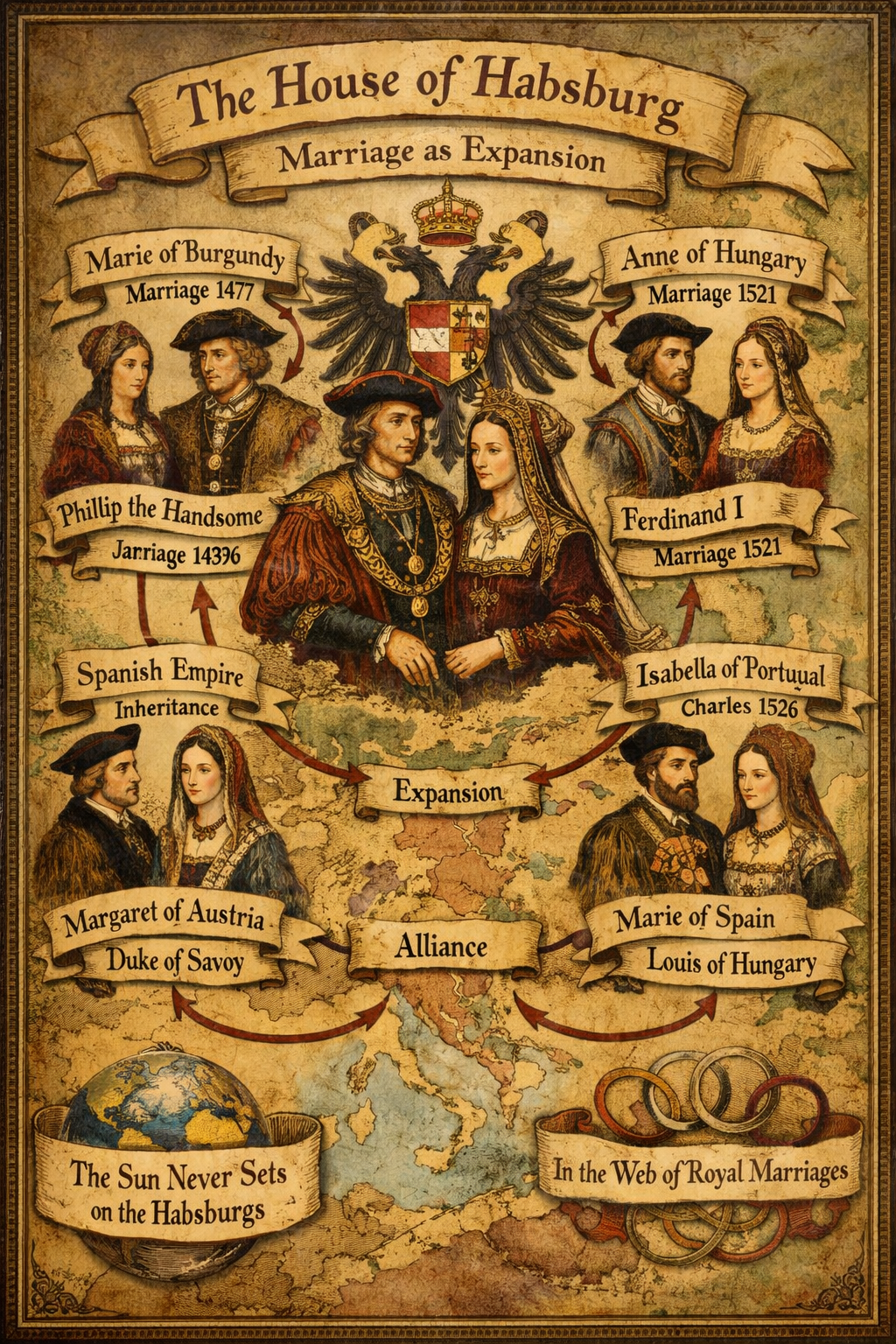
The House of Habsburg – Marriage as Expansion
Throughout history, power has rarely belonged to the loudest conqueror. Often, it belonged to the most disciplined strategist — the family that understood how to accumulate influence quietly, patiently, and across generations. Few dynasties illustrate this principle more clearly than the House of Habsburg. While many ruling houses relied on armies and conquest, the Habsburgs mastered a different art: expansion through marriage, financial leverage, and the subtle control of resources.
Their strategy was so effective that it became immortalized in a famous saying:
“Let others wage war; you, fortunate Austria, marry.”
For centuries, this philosophy allowed the Habsburgs to accumulate one of the largest and most powerful dynastic empires in European history. Their story reveals lessons about wealth, class, strategy, and power that remain deeply relevant today. Behind their marriages lay economic influence, resource control, and a disciplined understanding of elite networks — principles that modern investors, political financiers, and private equity firms continue to employ.
A Dynasty Built on Strategy Rather Than Conquest
The House of Habsburg originated as a relatively modest noble family within the Holy Roman Empire, yet by the 13th century had secured control of Austria and begun to pursue far broader ambitions. Unlike rival dynasties that relied heavily on military conquest, the Habsburgs developed a more enduring approach to power, recognizing that warfare was costly, uncertain, and often temporary, whereas strategic marriages could yield lasting influence. In aristocratic Europe, marriage functioned as a mechanism of statecraft rather than romance, facilitating the transfer of territory, titles, and legitimacy between ruling houses. Through carefully orchestrated unions over successive generations, the Habsburgs consolidated control over vast regions, including Austria, Bohemia, Hungary, Spain, the Netherlands, significant parts of Italy, and extensive overseas colonies. By the 16th century, their dominion spanned much of Europe and the Americas, not solely through battlefield success, but through a disciplined and patient dynastic strategy—an enduring example of long-term, structure-driven power.
Marriage as a Political Instrument
One of the most illustrative examples of House of Habsburg strategy was the 1477 marriage between Maximilian I and Mary of Burgundy. As the sole heir to the immensely wealthy Burgundian territories—encompassing much of modern-day Belgium, Luxembourg, and the Netherlands—Mary brought with her not only land, but access to some of the most prosperous commercial hubs in Europe. Through this single union, the Habsburgs secured vast economic resources, critical trade routes, and influential urban financial centers. This marriage is particularly instructive as an early form of strategic acquisition; where modern corporations pursue growth through mergers and acquisitions, the Habsburgs expanded through dynastic unions. Each marriage functioned as a calculated political contract, transferring wealth, influence, and legitimacy across elite networks. Over time, this approach produced an intricate web of alliances so deeply embedded that the Habsburgs became extraordinarily difficult to displace from the core power structures of Europe.
Control of Strategic Resources
While dynastic marriages secured territory, they also unlocked access to critical economic resources that underpinned Habsburg power. Many lands controlled by the House of Habsburg were among the most economically vital regions in Europe: the Low Countries dominated international trade, Spanish holdings provided access to vast flows of American silver, and Central European territories supplied significant agricultural output and mineral wealth. These assets formed the material foundation of political authority. However, the Habsburgs did not always administer this wealth directly; instead, they frequently relied on influential financial networks—most notably banking families such as the Fugger family—to fund imperial governance, military campaigns, and state administration. This arrangement fostered a symbiotic relationship between ruling dynasties and financial elites, in which sovereigns exercised authority while financiers supplied the capital necessary to sustain it. In modern terms, this mirrors the dynamic between governments and major financial institutions, where access to capital can shape political and economic outcomes. The Habsburg model thus represents an early and sophisticated form of financialized political power.
The Discipline of Dynastic Thinking
One of the defining characteristics of enduring dynasties is the capacity to think beyond a single lifetime, a discipline exemplified by the House of Habsburg. While many rulers pursued immediate glory, the Habsburgs prioritized long-term consolidation, carefully evaluating each marriage in terms of inheritance potential, political alliances, territorial expansion, and economic advantage. This deliberate, forward-looking approach closely parallels the mindset of modern family offices and dynastic wealth managers, where the emphasis lies not on short-term gains but on preserving capital, maintaining influence, and strengthening strategic positioning across generations. The Habsburgs understood a fundamental principle of power: it is rarely lost in a single decisive moment, but rather erodes through a series of poor long-term decisions. Their commitment to discipline, patience, and calculated expansion enabled them to sustain dominance over European political structures for centuries.
Quiet Financial Influence
Although the House of Habsburg is most closely associated with emperors and kings, its enduring power relied heavily on financiers operating behind the scenes. The maintenance of a vast empire demanded substantial capital to sustain warfare, infrastructure, administration, and diplomacy—resources that were often supplied by influential banking families such as the Fugger family. In exchange, these financiers secured privileged access to royal courts and meaningful political influence. This interdependence established an early model of political financing, in which economic power quietly shaped political outcomes. Clear modern parallels can be observed in political campaign financing, private equity participation in government contracts, corporate lobbying, and sovereign debt markets, where capital providers exert strategic influence over decision-making. The Habsburg system ultimately illustrates a consistent principle across history: that economic leverage frequently underpins and directs political power behind the scenes.
Elite Networks and Social Class
The House of Habsburg also provides a compelling illustration of how elite social networks function. Marriages among royal houses were never incidental; they were deliberately arranged within a closed and highly selective social class, forming what can be understood as a transnational aristocratic network. Membership in this network conferred significant advantages, including political legitimacy, military alliances, access to capital, and the flow of strategic information. This structure closely mirrors the operation of modern elite networks, where influential families, investors, and political actors remain interconnected through institutions such as elite universities, exclusive clubs, and global business circles. These networks serve to consolidate and perpetuate influence across generations. Long before the emergence of modern globalization, the Habsburgs had already mastered the art of leveraging tightly knit social systems to sustain and expand their power.
The Hidden Cost of Dynastic Strategy
Despite its remarkable success, the strategy of the House of Habsburg carried inherent risks. Persistent intermarriage within a tightly closed aristocratic network gradually produced genetic complications, most notably within the Spanish branch of the dynasty. Over successive generations, closely related unions contributed to the physical and political decline of the royal line, culminating in the death of Charles II of Spain in 1700 without an heir—an event that triggered the War of the Spanish Succession. This episode underscores a critical strategic lesson: systems that concentrate power too narrowly within closed structures can become fragile over time. Modern financial empires face similar vulnerabilities when influence is overly centralized, reinforcing the need for both discipline and adaptability. Although royal dynasties no longer dominate Europe, many Habsburg principles persist within contemporary economic systems. As explored in The House of Rothschild, modern private equity firms and large investment funds often mirror dynastic expansion strategies—acquiring companies, infrastructure, and key resources through mergers, partnerships, and strategic control. Like Habsburg marriages, these acquisitions enable influence to expand quietly and effectively, shaping power structures behind the scenes without the need for overt conflict.
Commodity Dominance and Resource Control
A further modern parallel can be seen in the control of strategic resources. Much like the House of Habsburg consolidated power through dominance over key trade regions and access to colonial wealth, contemporary corporations and institutional investors increasingly seek influence through the control of critical commodities and infrastructure. This includes energy networks, agricultural supply chains, rare earth minerals, and global shipping routes—assets that form the backbone of economic security. Those who command these resources possess significant leverage over both governments and markets, reinforcing a timeless principle of political economy: control of essential resources translates directly into influence. The Habsburgs recognized this dynamic centuries ago by securing territories rich in trade and mineral wealth, a strategy that continues to echo in modern systems of power. For a deeper exploration of how resource control shapes global influence, see The Prize: The Epic Quest for Oil, Money & Power, which examines the enduring relationship between energy, capital, and geopolitical strategy.
Political Financing in the Modern Era
In the modern world, political power is no longer anchored in hereditary dynasties such as the House of Habsburg, yet financial influence remains a decisive force in shaping political outcomes. Mechanisms such as campaign financing, lobbying networks, and investment relationships enable wealthy actors to exert meaningful influence over policy and governance. Much like the Habsburgs’ reliance on powerful financiers to sustain their empire, contemporary governments depend heavily on capital markets and institutional investors, creating an intricate and often opaque relationship between wealth and political authority. This dynamic is essential to understanding modern political economy and elite power structures, where influence is frequently exercised indirectly through financial channels. As explored in Capital in the Twenty-First Century, the concentration and deployment of capital continue to shape societal outcomes in profound ways. While history does not repeat itself exactly, its underlying patterns consistently echo across time.
The Philosophy of Dynastic Power
The story of the House of Habsburg ultimately invites deeper philosophical reflection on how certain families and institutions sustain power across generations. Their endurance can be traced to a set of recurring principles: a commitment to long-term thinking, where decisions are made with a multi-generational horizon rather than short-term gain; the cultivation of network control, recognizing that influence flows as much through relationships as through capital; the strategic command of key resources, which provides durable and defensible power; and a disciplined approach to decision-making that avoids impulsive actions capable of undermining long-term stability. These principles extend far beyond historical dynasties, remaining highly relevant in modern contexts such as business, investing, and personal financial strategy, where enduring success is often built on the same foundations of patience, structure, and strategic foresight.
Contact
Reach out for insights or collaboration.
Phone
© 2025. All rights reserved.